


The cumulative number of confirmed cases of Ebola virus disease has now reached 7,200 in the seven provinces of the Democratic Republic of Congo (DRC) affected by the epidemic, according to the epidemiological report published on Sunday, September 13, 2026.
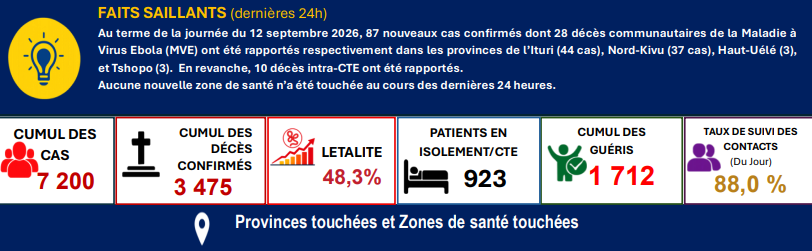
Of these cases, 923 patients are currently in isolation or hospitalized. The cumulative number of recoveries stands at 1,712, while 3,475 deaths have been recorded among confirmed cases. The overall case fatality rate is 48.3%, while the overall contact tracing rate reaches 88%.
According to the same report, 62 health zones spread across seven provinces are affected by the epidemic.
In Ituri, the health zones concerned are Aru, Aungba, Bambu, Bunia, Damas, Drodro, Gety, Kilo, Komanda, Lita, Logo, Mambasa, Mangala, Mongbwalu, Nizi, Nyankunde, Rimba, Rwampara, Tchomia, Kambala, Nia-Nia, Fataki, Mandima, Lolwa, Boga, Ariwara, Mahagi and Adja.
In North Kivu, these are Beni, Biena, Butembo, Goma, Kalunguta, Katwa, Kyondo, Oicha, Vuhovi, Lubero, Mabalako, Masereka, Musienene, Mutwanga, Manguredjipa and Kayna.
In South Kivu, only the Miti-Murhesa health zone is affected.

In Haut-Uélé, the affected areas are Boma Mangbetu, Gombari, Isiro, Pawa, Rungu and Wamba. In Bas-Uélé, they are Buta, Viadana and Ganga.
Tshopo has six affected health zones: Bafwasende, Kabondo-Lubunga, Makiso-Kisangani, Mangobo, Wanie-Rukula, and Tshopo. South Ubangi, on the other hand, has only one affected health zone, namely Bulu.
The report also indicates that the epidemic peak was reached during the third week of August 2026, with a gradual trend towards a decline in the curve of confirmed cases and deaths.
The response continues, notably through active surveillance in the affected provinces, systematic investigation of suspected cases, and enhanced contact tracing. In the last 24 hours, 20 additional patients have been declared recovered.