


According to the latest Democratic Republic of the Congo (DRC) Ebola update, 8,978 confirmed Ebola cases, 4,336 deaths (48.3% fatality rate), and 2,356 recoveries across 7 provinces and 65 health zones were reported as of October 10, 2026.
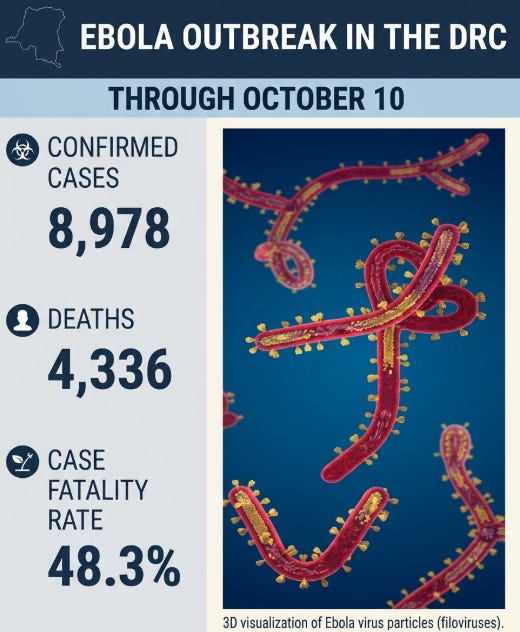
Positive trends include 18 new recoveries in 24 hours and no new confirmed cases in Bas-Uélé, Sud-Kivu, or Sud-Ubangi, with 945 patients currently isolated.
Response efforts feature 81% contact tracing, border screening of over 250,000 travelers, and community sensitization, with hotline 151 for suspected cases.
This is a severe, ongoing national public health crisis for the DRC—the largest Ebola outbreak in the country’s history (and the second-largest ever recorded globally).
Emerging Infectious Diseases and Global Health Security
Eastern DRC (especially Ituri and North Kivu) faces ongoing armed conflict, population displacement, poor infrastructure, and limited access to services. This hinders response efforts: many deaths still occur in communities (indicating delayed detection and care), there are reports of attacks on or pressure on health facilities, community mistrust, and challenges reaching some areas.
The virus is the Bundibugyo strain, for which there is no licensed vaccine or specific approved treatment (unlike the more common Zaire strain). Care relies on supportive treatment, infection control, contact tracing, and safe burials; experimental candidates are being evaluated in trials.
Broader effects include strain on the health system and socioeconomic costs. Resources are diverted from routine care, with projections of excess deaths from other diseases (e.g., among infants). A UNDP assessment has warned of potential real GDP losses exceeding $1 billion in the DRC even under relatively contained scenarios, tens of thousands of job losses, and nearly a million additional people pushed into poverty, with disproportionate effects on poorer households and women. Mining and informal economies in affected areas have also been disrupted. WHO assesses the risk as very high for the DRC itself, high for neighboring countries, and low globally; a Public Health Emergency of International Concern (PHEIC) remains in effect, with limited exportations so far (e.g., a contained outbreak in Uganda and one imported case in Kenya).
The figures show a still-active, high-mortality epidemic that is testing DRC’s response capacity in a conflict zone, with lasting health and economic consequences even as some containment progress appears in certain provinces. International partners continue supporting the response, but access, community engagement, and the lack of strain-specific tools remain major constraints.
Your line about "one imported case in Kenya" was accurate when this was published on Monday — it isn't anymore. This morning Kenya's Ministry of Health confirmed a second case: a 39-year-old man, a close family contact of the first patient, who was already in quarantine under daily monitoring when he developed fever, fatigue and joint pain on Tuesday. Samples tested positive at both the National Virology Reference Laboratory and KEMRI-CDC, and he was moved to a designated treatment centre for supportive care.
What's worth flagging is that this is contact tracing working as designed — the case was caught inside the monitoring window, before community spread. The ministry reports 113 of 128 contacts traced, 108 in 21-day quarantine, and says both cases are linked with no evidence of wider community transmission.
One question your piece raises for me: you note there is no licensed vaccine or approved treatment for the Bundibugyo strain. If exportations keep getting detected despite border screening — Uganda's outbreak, now two Kenyan importations — does the containment model hold on quarantine alone, or do we need the experimental candidates you're tracking to show Bundibugyo-specific activity soon?