


Democratic Republic of the Congo (DRC) and Uganda
In a follow-up on the Ebola Bundibugyo virus disease (BVD) outbreak in the Democratic Republic of the Congo (DRC) and Uganda, the World Health Organization (WHO) reports a total of 528 suspected cases, including 132 deaths have been reported from both countries.
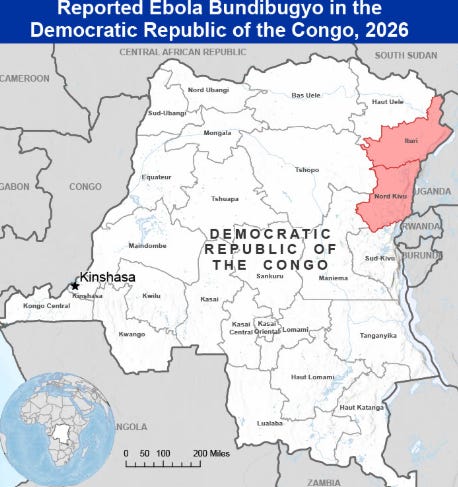
As of 18 May 2026, the DRC has reported 516 suspected cases, including 131 deaths from seven health zones across Ituri and North Kivu Provinces. Of these, 33 cases with four deaths have so far been confirmed from Rwampara (19), Bunia (6), Nyankunde (4), and Mongbwalu (1) HZsin Ituri Province, and Butembo (1), Goma (1), and Katwa (1) in North Kivu Province.
Of the 12 suspected cases reported from Uganda, two were confirmed through laboratory testing, while the rest tested negative.
A total of 668 contacts have so far been identified, including 541 in DRC and 127 in Uganda, although contact follow-up remains challenging in some areas of DRC due to insecurity and movement restrictions. Numbers are rapidly changing as surveillance, contact tracing and laboratory testing are being scaled up.
Ebola Q & A with infectious disease experts Smith and Racaniello 2015 interviews
The outbreak presents a high risk of continued transmission and regional spread because of ongoing population movement and healthcare-seeking patterns across affected areas. Ituri Province borders Uganda and South Sudan, while Bunia functions as a commercial and transport hub, facilitating substantial population mobility and cross-border movement. Transmission risks are further amplified by mining activities, insecurity, weak contact follow-up, delayed detection, and movement of symptomatic individuals across health zones and international borders.
South Africa support
The Government of South Africa has pledged US$2.5 million to support the ongoing Ebola response in the Democratic Republic of the Congo (DRC) and Uganda through the Africa CDC Africa Epidemics Fund.
This support will contribute to strengthening critical response operations, including continental coordination, surveillance, laboratory systems, rapid response deployment, infection prevention and control, cross-border preparedness, and support for affected communities.
American Ebola case
According to the Centers for Disease Control and Prevention (CDC), an American who was exposed as part of work caring for patients in DRC tested positive for Ebola Bundibugyo disease on May 17.
The patient has been transported to Germany for treatment and care. In addition to being a shorter flight time, Germany has previous experience caring for Ebola patients.