


According to Public Health France, as of September 28, 2026, six new autochthonous chikungunya cases were reported during the past week.
This brings the total local transmission cases of chikungunya to 125.
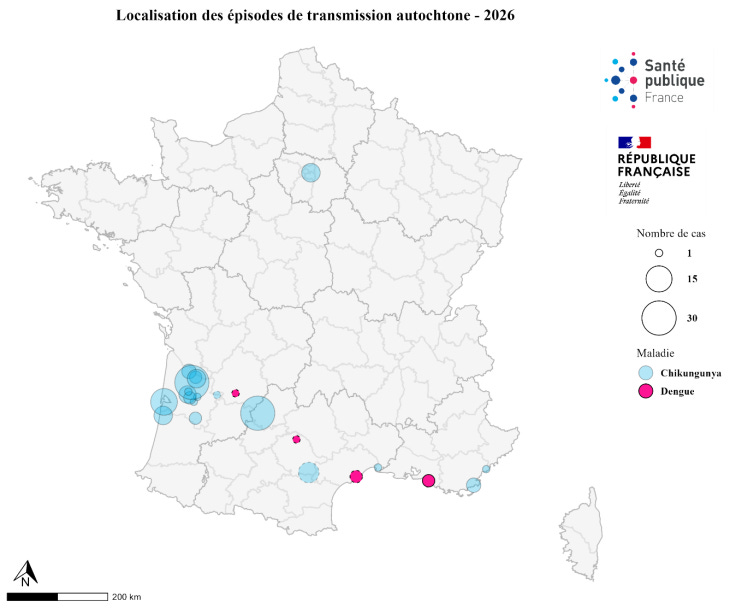
No new dengue were reported, leaving the total as six locally transmitted dengue cases this year.
Concerning West Nile virus (WNV), 28 additional cases were reported in the past week, bringing the total WNV to 145 autochthonous cases.
They are located in the regions of Provence-Alpes-Côte d’Azur (3 departments involved), Occitanie (7 departments involved), Île-de-France (7 departments involved), Auvergne-Rhône-Alpes (3 departments involved), Nouvelle-Aquitaine (Gironde department), Pays de la Loire (3 departments involved), and Centre-Val de Loire (Loiret department). For 14 cases, no precise location of contamination could be identified.
What a mirror image of the other side of the Atlantic. This publication just documented Florida's largest locally-acquired dengue outbreak in decades — 252 local cases — and here France logs 145 autochthonous West Nile cases, a record, plus 125 local chikungunya cases and 6 dengue, all in the same season. 2026 is shaping up as a banner year for arboviruses on both sides of the ocean.
One angle worth watching from the pharmacy side: West Nile is transfusion-transmissible, so the blood-supply question follows every surge. Fewer than 1% of infections turn neuroinvasive, so the absolute count stays small — but the skew toward older adults is exactly the population that donates and receives the most blood. Do the French blood authorities scale up NAT screening or donor deferral geographically as the case map expands, the way outbreak-driven deferral policies work elsewhere?
And with Culex-borne West Nile and Aedes-borne chikungunya and dengue now co-circulating across seven regions including Île-de-France, I wonder whether vector-control programs are still siloed by mosquito genus — or finally being run as a single arbovirus campaign.