


The measles outbreak in southwest Wisconsin began with a rash onset date in early July 2026, though it was officially reported to the public in August 2026.
Since that time, Wisconsin health officials have reported 220 confirmed and 6 probable cases in the outbreak in Grant, Iowa, Lafayette, and Vernon Counties.
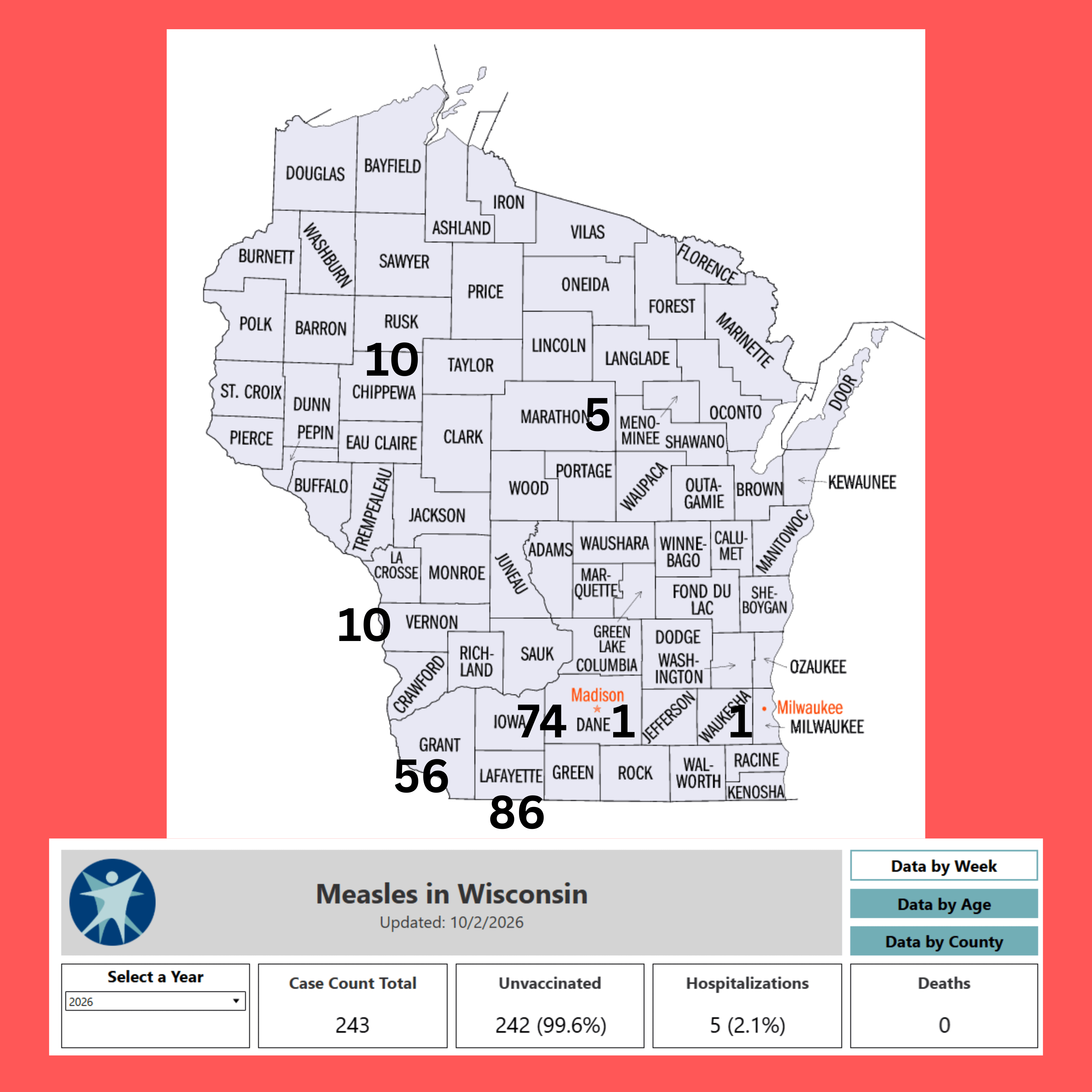
The ongoing investigation indicates that measles is spreading locally. The Wisconsin Department of Health Services (DHS), in coordination with Grant, Iowa, Lafayette, and Vernon County Health Departments, are working to identify and notify people who may have been exposed to the measles virus.
Statewide, the DHS reports 243 cases this year, covering eight counties: Lafayette County (86 cases), Iowa County (74 cases), Grant County (56 cases), Vernon County (10 cases), Chippewa County (10 cases), Marathon County (5 cases), Dane County (1 case reported in February) and Waukesha County (1 case reported in January).
Currently, Wisconsin has reported the 4th most measles cases in 2026, following Pennsylvania (977), South Carolina (671) and Utah (527).
Emerging Infectious Diseases and Global Health Security
According to the Centers for Disease Control and Prevention, 3,887 confirmed measles cases were reported in the United States in 2026.
Measles is a disease caused by the measles virus. Measles can be dangerous, especially for infants and young children.
One out of every four people who get measles in the United States will be hospitalized. One or two out of every 1,000 children in the United States who get measles will die from the disease, even with the best care.
Measles can cause serious health problems, such as:
Pneumonia, an infection of the lungs.
Brain damage caused by swelling.
Deafness.
You can protect yourself and the people around you from measles. The best protection against measles is a measles, mumps, and rubella (MMR or MMRV) vaccine.
Two doses of the measles vaccine are about 97% effective at preventing measles. The vaccine provides long-lasting protection against all strains of measles.