


The Centers for Disease Control and Prevention (CDC), along with officials from several states and the U.S. Food and Drug Administration (FDA), report investigating a multistate salmonella outbreak (Salmonella Telelkebir).
Early data shows that oysters may be contaminated with Salmonella and may be making people sick in this outbreak. CDC and FDA are working to determine the source of these oysters.
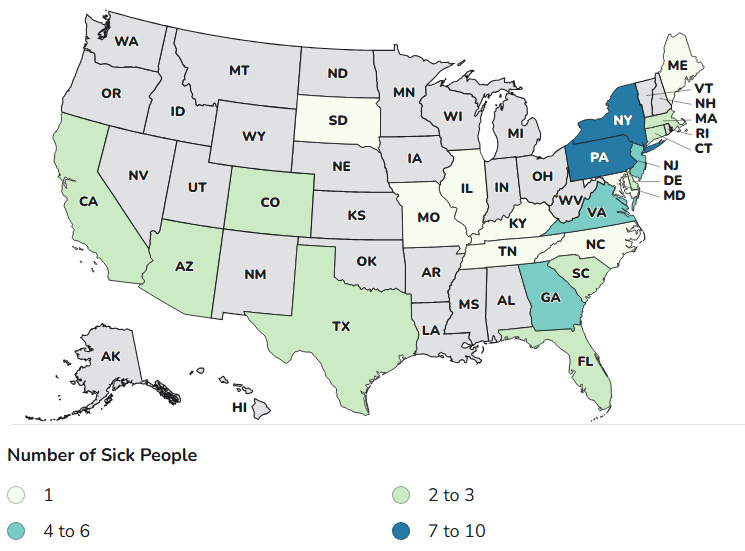
As of December 23, 2025, 64 people infected with the outbreak strain of Salmonella have been reported from 22 states- Pennsylvania (10), New York (7), Virginia and New Jersey (6 each), Georgia (4), 3 each in Arizona, Colorado, Florida, Massachusetts and South Carolina, 2 each in California, Connecticut, Delaware and Texas and one each in Illinois, Kentucky, Maine, Missouri, North Carolina, South Dakota, Tennessee and Maryland.
Of 44 people with information available, 20 have been hospitalized. No deaths have been reported.

State and local public health officials are interviewing people about the foods they ate in the week before they got sick. Of the 27 people interviewed, 20 (74%) reported eating raw oysters.
CDC advises:
Raw oysters can be contaminated with germs at any time of year. Cook oysters before eating to reduce your risk of food poisoning.
Do not let raw seafood, its drippings, or its juices contaminate other foods.
You cannot tell if an oyster has germs by looking at it.
Hot sauce and lemon juice do not kill germs.
To cook oysters in their shells:
Boil until shells are open, OR
Add to a steamer that is already steaming and cook for 4 to 9 minutes.
Only eat shellfish that open during cooking.
Choose one of the following methods for cooking oysters out of their shells:
Boil for at least 3 minutes.
Fry in oil for at least 3 minutes at 375° F.
Broil 3 inches from heat for 3 minutes.
Bake at 450° Fahrenheit for 10 minutes.
Cook seafood until the inside reaches a temperature of 145°F for at least 15 seconds.
Salmonella
Most people infected with Salmonella develop diarrhea, fever, and stomach cramps 6 hours to 6 days after being exposed to the bacteria.
The illness usually lasts 4 to 7 days, and most people recover without treatment.
In some people, the illness may be so severe that the patient is hospitalized.
Children younger than 5, adults 65 and older, and people with weakened immune systems are more likely to have severe illness.